Two small gray words sit under a message. Seen 9:41.
That's all they say. They don't say Seen, and smiled. They don't say Seen, and is about to write something lovely. They just sit there, under the text you sent your sister about Sunday lunch, and it is now 10:17.
You wrote, "Sounds good! What can I bring?"
She wrote, "ok."
Lowercase. No period. No heart. She always adds a heart.
You've opened the chat eleven times since then. You've scrolled up to check whether you said something odd earlier in the week. You've drafted a follow-up. Just checking you're all right? Deleted. No pressure about Sunday! Deleted. Haha ignore me, I'm being weird. Deleted, because that one sounded the most weird of all.
The phone is warm in your hand.
And it isn't only sisters and texts. The same alarm goes off over a one-word "Fine." from a partner, a "See me tomorrow" from a boss, or a teenager's silence at the dinner table.
What this chapter is for
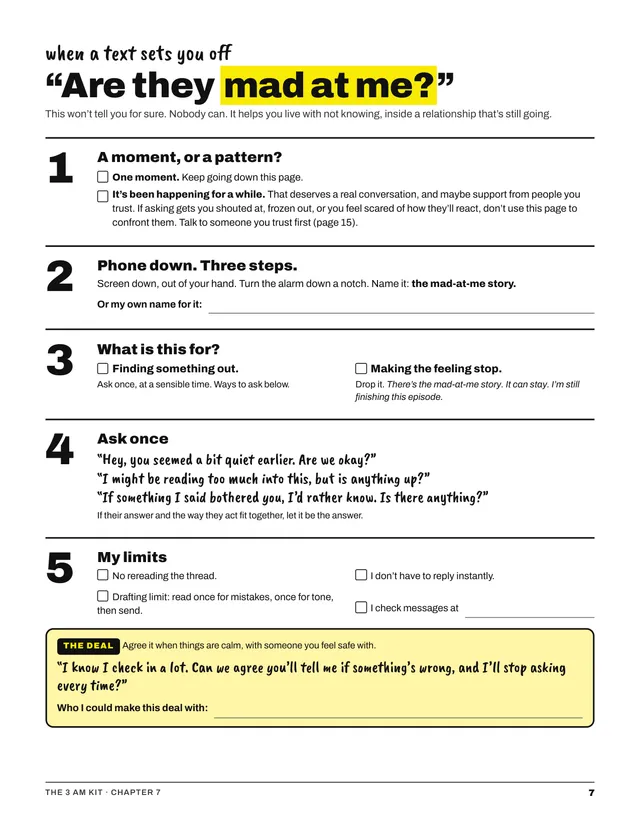
This chapter won't tell you how to find out for sure whether someone is mad at you. Nobody can.
What it will do is help you live with not knowing, inside a relationship that's still going. A friendship, a partner, someone you've just started seeing, a sister who writes "ok." That means saying what you need to say, noticing when you've slipped into checking, setting a few limits for yourself, and waiting, which is the hardest one.
Why the people you love set it off loudest
A short reply from a stranger can sting, especially if social situations make you anxious. But for most of us, a short reply from someone close lands much harder.
The alarm guards what matters most, and the people close to us matter more than almost anything. A short reply from your best friend can feel like a door slamming. That's not a flaw. It means you care. Caring, plus a jumpy alarm, plus a phone that tells you exactly when someone read your message, is just a tricky mix.
A moment or a pattern?
One short text is a moment. Your sister might be tired. She might be on the bus. She might be arguing with her landlord. "ok" could mean a hundred things, and two letters won't tell you which.
A pattern is different. If someone is regularly cold with you, dismissive, or makes jokes at your expense, that's information. If someone is warm one week and vanishes the next, over and over, so you never know where you stand, that's information too.
Calming your alarm should never mean ignoring a real pattern. The tools in this book are for the loop, not for talking yourself out of what you can plainly see.