


A guided journal by Olivia K. Renner
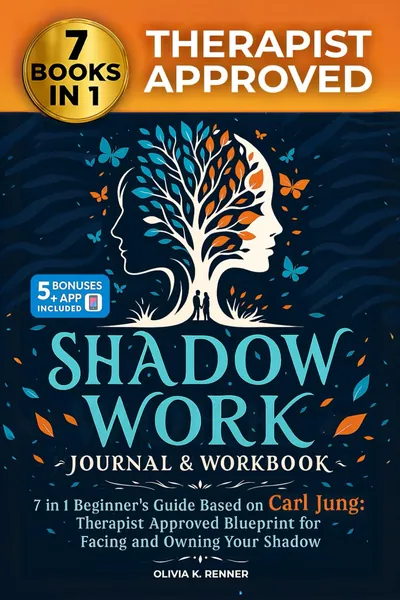
Shadow Work Journal and Workbook: 7 in 1 Beginner’s Guide Based on Carl Jung: Therapist Approved Blueprint for Facing and Owning Your Shadow
A guided journal for meeting the parts of yourself you learned to hide, one honest page at a time.
- 241 pages
- 7 parts, 28 chapters
- 100+ guided prompts
Approved by Mia Micevska, Clinical Neuropsychologist
Paperback, hardcover, Kindle and audiobook.
We publish this book. As an Amazon Associate we earn from qualifying purchases.

As shared in the TikTok videos
Is this the journal from TikTok?
Yes. The dark blue cover with the tree, the pages with the highlighted lines, the book that comes out of the box at the end of the video: this is that journal. No searching needed, it is right here.
Look inside
These are real pages from the book. Most journals for shadow work hand you prompts and leave you to it. This one explains each idea in plain language first, then gives you a spread of questions and space to write.
- Real interior pages
- A writing spread in every chapter
- 6 x 9 in softcover


Fourteen places in the book
One or more from each of the seven parts.
- Part 1


Chapter 1 opens with a welcome and a plain explanation of the shadow.
- Part 1


Your first writing spread: four questions and room to answer.
- Part 1


Ideas from Carl Jung, explained in plain words.
- Part 2

A trigger worksheet: name the person or moment that sets you off.
- Part 2

How everyday habits can carry an old, unspoken message.
- Part 3

Describe a reaction that was bigger than the moment.
- Part 3


Write a conversation with your inner critic, in your own hand.
- Part 3


Your inner team: two voices in conflict, and a first step toward a compromise.
- Part 4

A forgiveness prompt: the resentment you still carry.
- Part 5

Boundaries as lines you draw for yourself, not walls.
- Part 5


Prompts on rest: what are you afraid to give up?
- Part 6


Dream prompts: notice a recurring symbol and what it asks of you.
- Part 7

Part 7 asks what a hard experience has taught you.
- Part 7

The last question in the book.
What it does for you
Seven parts, three movements. You go at your own pace, and you can stop at any page.
-
Learn what the shadow is and start spotting it where it actually shows up: in the people who irritate you, the habits you cannot shake, and the qualities you quietly admire in others.
Page 19 -
Meet your inner critic and your inner child, write a conversation with the parts of you that feel rejected, and work through projection, paradox and forgiveness.
Page 87 -
Bring what you find back into ordinary days: your own voice, your boundaries, creativity and rest, your dreams and intuition, and a closing synthesis you can return to whenever you need it.
Page 156


The seven parts, in order
- 1
The First Step: Recognizing the Shadow
What the shadow is, why we hide parts of ourselves, and the first signs it is active.
- 2
The Mirror and The Echo: The Shadow in Everyday Life
Projection and judgment, what other people trigger in you, habits, and the gifts hidden in the dark.
- 3
Facing the Voices
The inner critic, the inner child, writing a conversation with your shadow, and the inner team.
- 4
The Path to Integration: Bringing Light to Darkness
Taking back projections, holding paradox, forgiveness, and self-compassion.
- 5
The Authentic Life: Living with Your Whole Self
Your own voice, boundaries, creativity, and rest.
- 6
The Integrated Self: The Ongoing Journey
Archetypes, dreams, intuition, and the cycles of integration.
- 7
The Master of the Self: The Grand Synthesis
Turning pain into meaning, wholeness, the collective shadow, and a new beginning.

Who it is for
- You react more strongly than a moment deserves and want to understand why.
- You are new to shadow work and want structure instead of a list of vague prompts.
- You think best on paper and want generous room to write.
- You are curious about Carl Jung's ideas but want them in plain English.
- You want a calm, private practice you can do at your own pace.
Who it is not for
- You want a quick fix. This is slow, honest work over weeks, not a weekend.
- You are looking for rituals, spells or manifesting. This book stays with psychology and writing.
- You are in crisis right now. Please contact a licensed professional or a crisis line first. In the US you can call or text 988.
This journal is a tool for self-reflection. It is not a substitute for therapy or professional care. Some prompts can bring up strong feelings, so go slowly, skip anything that feels like too much today, and reach out for support when you need it.
Approved by Mia Micevska, Clinical Neuropsychologist
Free companion pack
Readers get free printable PDFs, including a Core Values exercise, plus a free review course in the Quizlet app so you can revisit the ideas on your phone.
Enter your email on the next page and we send you the download link. Unsubscribe anytime.
The QR code inside the book leads to the same page.


About Olivia K. Renner
Olivia K. Renner writes guided journals that are warm without being soft-headed. She is drawn to Carl Jung's idea that the parts of us we push away keep shaping our days, and she likes turning big ideas into plain questions you can actually answer on paper. Her books favor structure, honesty and plenty of room to write, and they never promise more than a journal can keep.
Olivia K. Renner is a pen name. Her books are published by Kalderno (Quicktale Limited).
Questions

Is this the shadow work journal from TikTok?
Yes. Shadow Work Journal and Workbook: 7 in 1 Beginner’s Guide Based on Carl Jung by Olivia K. Renner is the journal shown in the TikTok videos. It is a real 241-page book, available as a paperback, a hardcover, a Kindle ebook and an audiobook.
What is shadow work?
Shadow work is the practice of noticing and getting to know the parts of yourself you learned to hide or reject, such as anger, need or ambition. The idea comes from the Swiss psychiatrist Carl Jung, who called those hidden parts the shadow. In this journal you do it in writing, one guided question at a time.
How do you do shadow work with a journal?
You read a short chapter that explains one idea, then answer the prompts on the writing pages that follow. You notice a reaction, ask where it comes from, and write without editing yourself. The book starts with gentle questions and moves to deeper ones across its seven parts.
Is this journal good for beginners?
Yes. It is written as a beginner's guide. Every idea is explained in plain language before you are asked to write, and the early prompts are simple before the book moves on to the inner critic, the inner child and boundaries.
Is shadow work safe?
Shadow work can bring up strong feelings, so go slowly and skip any prompt that feels like too much for today. This journal is a self-reflection tool, not a substitute for therapy. If you are struggling, please talk to a licensed professional.
Is shadow work spiritual or witchcraft?
Not in this book. This journal approaches shadow work through Carl Jung's psychology and reflective writing, not through witchcraft or any religion. You do not need any belief system to use it.
Who is Olivia K. Renner?
Olivia K. Renner is the pen name behind Shadow Work Journal and Workbook 7 in 1. She writes guided journals that turn Carl Jung's ideas into plain questions, and her books are published by Kalderno.
Which format should I get?
Choose the paperback if you want to write in the book itself; it is a 6 by 9 inch softcover with lined writing pages. The hardcover has the same 241 pages in a sturdier binding. The Kindle ebook and the audiobook suit reading or listening, with your answers in a notebook of your own.
We publish this book. As an Amazon Associate we earn from qualifying purchases.


Start with one honest page.
Pick the format that fits how you like to reflect.
We publish this book. As an Amazon Associate we earn from qualifying purchases.
Olivia K. Renner is a pen name. Published by Kalderno, Quicktale Limited.
